Maximising Value Across the Asset Lifecycle

Creating Value Beyond Ownership
Asset management, in its broadest sense, is the systematic management of assets throughout their lifecycle with the objective of maximising value, income, and risk-adjusted returns. At its core, it is about optimising return on investment (ROI) through strategic oversight, disciplined execution, and continuous performance monitoring.
While most commonly associated with financial markets, where professionals manage portfolios of securities, the same principles apply across real estate, infrastructure, and corporate assets. In all cases, asset managers operate at a strategic level: defining direction, allocating capital, and making buy, hold, or sell decisions, while remaining accountable for performance.
“Asset management is not about owning assets, it is about actively creating value from them.”
The Asset Management Process
The asset management cycle follows a structured, decision-driven approach:
- Identification & Evaluation
Potential investment opportunities are analysed based on expected returns, risks, and alignment with investment strategy.
- Acquisition
Assets are acquired in line with clearly defined investment objectives.
- Active Management
Continuous monitoring, optimisation, and maintenance ensure assets perform efficiently—whether physical (e.g. real estate) or financial.
- Disposition
Assets are sold when they no longer meet strategic criteria or when their value has been maximised.
Types of Assets
Tangible Assets
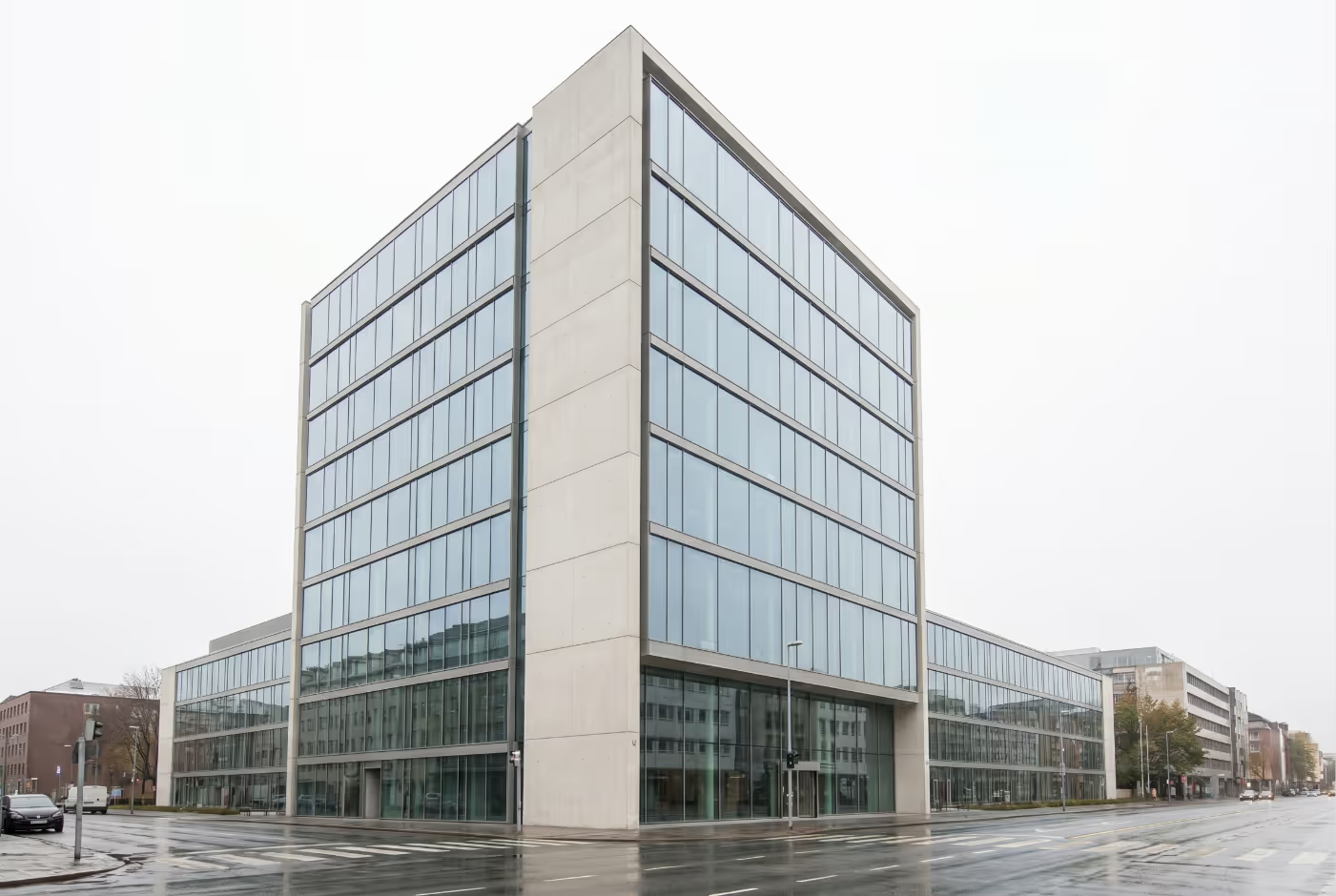
Physical assets such as real estate, infrastructure, or equipment. Their value is anchored in their physical utility, making them generally more resilient during market volatility. Management focuses on maintenance, efficiency, and long-term planning.
Intangible Assets
Non-physical assets including financial instruments and intellectual property. Their management centres on performance optimisation, valuation, and risk management.
Key Asset Management Disciplines
Real Estate Asset Management
Focused on income-generating properties, with the objective of maximising rental income, occupancy stability, and asset value through leasing, repositioning, and strategic timing of exit.
Investment Portfolio Management
Involves managing diversified financial assets, balancing risk and return while aligning with investor objectives.
Enterprise Asset Management (EAM)
Covers operational assets such as machinery and infrastructure, with a focus on lifecycle planning, efficiency, and minimising downtime.
Hedge Fund Management
An active, opportunistic approach targeting absolute returns through complex and flexible investment strategies.
Private Equity
Focused on acquiring and improving companies, enhancing operational and financial performance to maximise exit value.
Venture Capital
Investment in early-stage, high-growth companies, with active involvement in strategy, scaling, and development.
Mutual Funds
Highly regulated, diversified investment vehicles aiming for stable, benchmark-driven returns with controlled risk.
Asset management provides the structure and discipline required to unlock the full potential of assets. By combining strategic oversight with active management, it ensures that both tangible and intangible assets are utilised efficiently, risks are controlled, and performance is continuously optimised.
In essence, effective asset management transforms ownership into sustainable value creation.


.avif)